
LéXPLORE Blog #1B – January 2025
A late algal growth after the Benjamin storm
In early November, you might have noticed that Lake Geneva looked slightly greener than in October. This was due to a surprisingly late algal growth in the surface waters that lasted for about two weeks. Let’s éXPLORE what caused it!
A sudden algal growth
Lake Geneva turned greener in early November. Satellites images show that surface concentrations of chlorophyll – a green pigment that indicates the presence of microalgae in the water – increased between 30 October and 4 November 2025, reaching values around 5 mg m-3 near Lausanne (Fig.1).
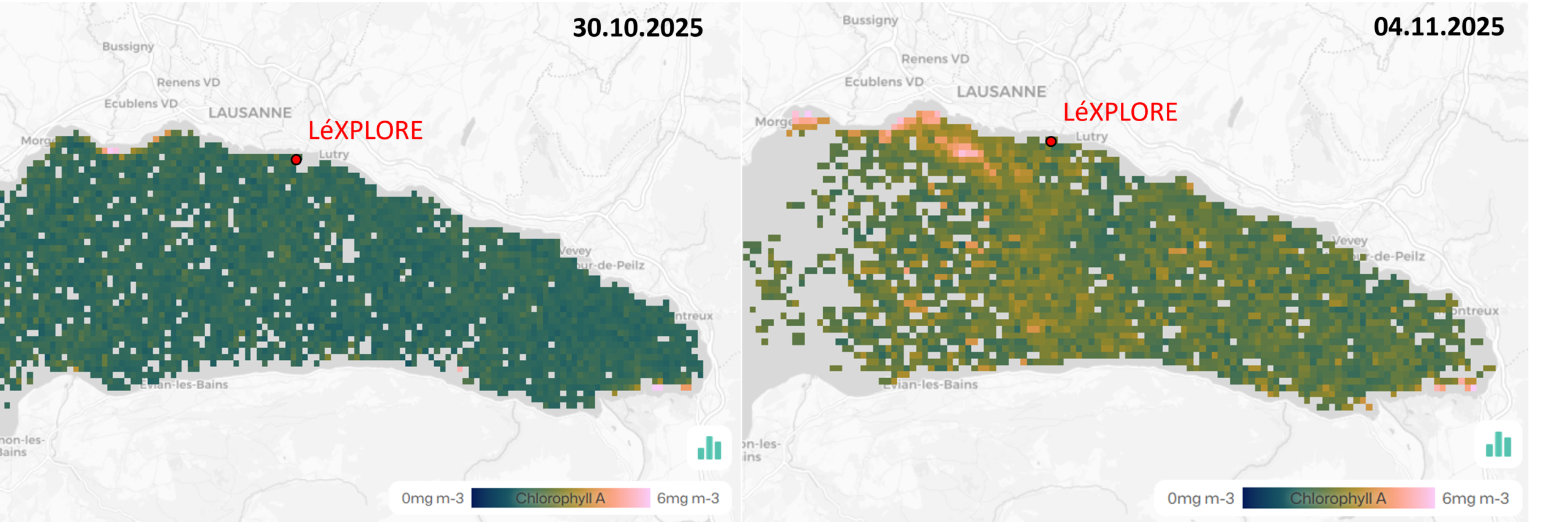
Figure 1 – Surface chlorophyll concentrations captured by the Sentinel-3A satellite on 30 October (left) and 4 November (right). Data publicly available at
https://www.alplakes.eawag.ch/map/geneva?layers=satellite_chlorophyll.
The rise in chlorophyll indicates a sudden growth of microalgae –called phytoplankton – that was also observed at LéXPLORE (Fig. 2). The algal growth started on 31 October and persisted for about two weeks across the lake surface layer (0-30 m depth). Water samples collected at LéXPLORE showed that Fragilaria sp. (Fig. 3) was one of the phytoplankton species developing at this time.
But why did phytoplankton start to grow on Halloween, well past the usual growing season? Before blaming witches, ghosts, or lake monsters, let’s look at what really happened a few days earlier…
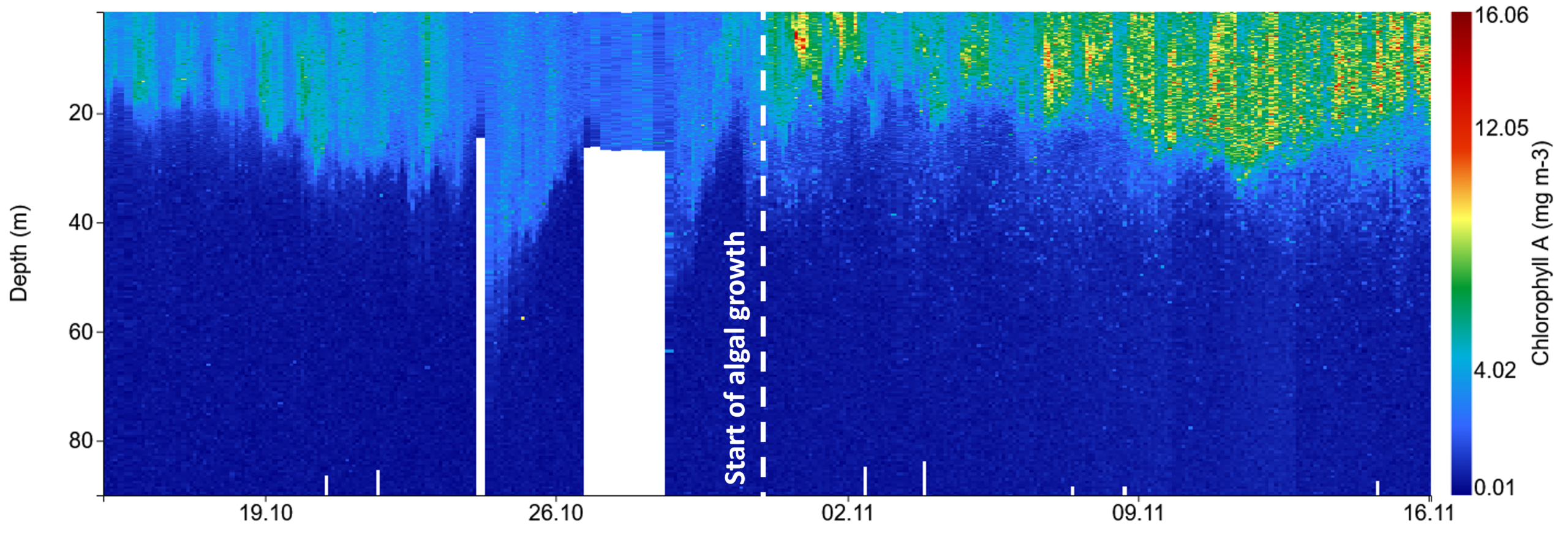
Figure 2 – Chlorophyll concentrations measured by the Idronaut at LéXPLORE as a function of time and depth. The vertical white dashed line indicates the start of algal growth on 31 October. Data publicly available at https://www.datalakes-eawag.ch/datadetail/666.
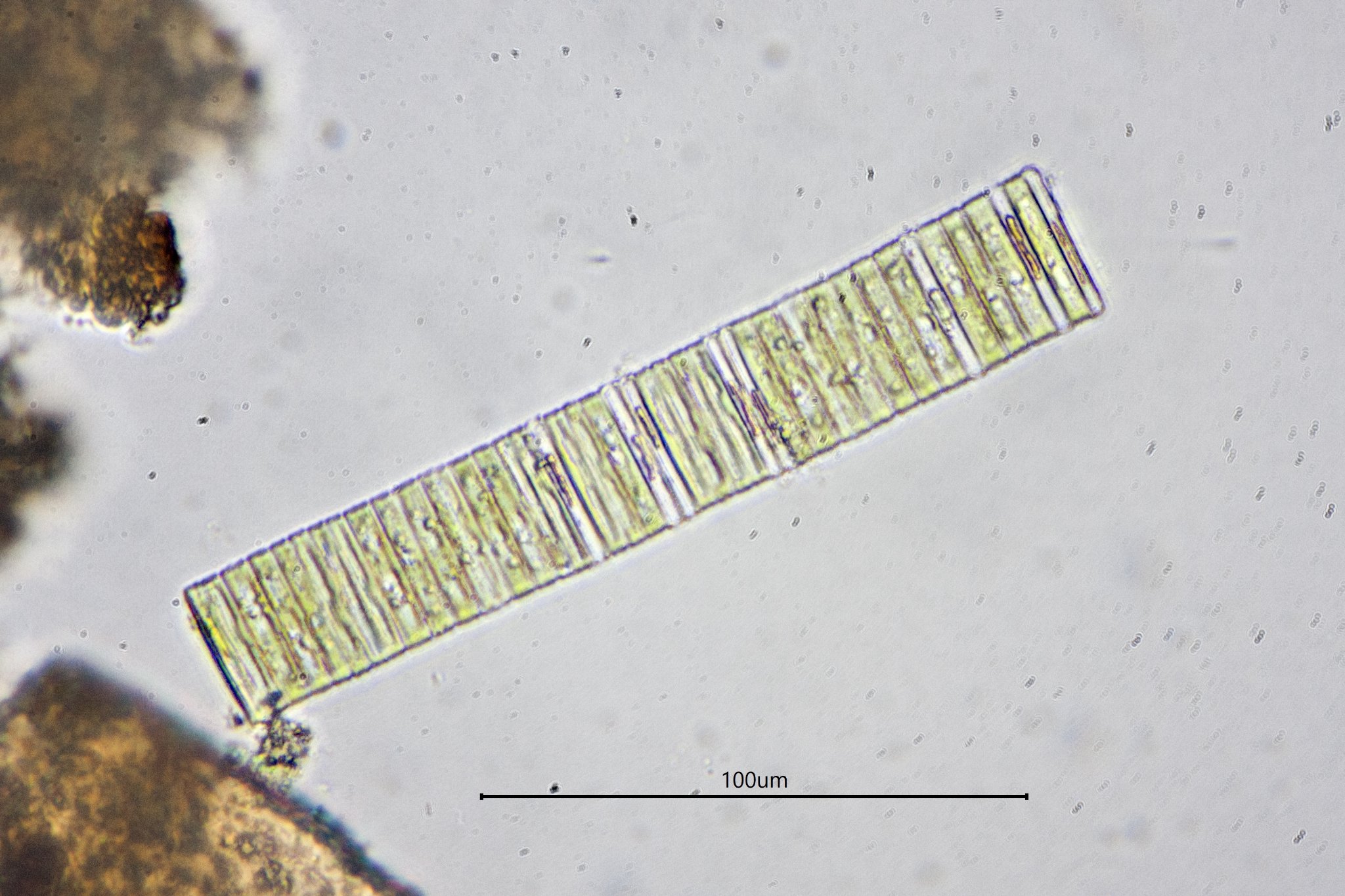
Figure 3 – Microscopic image of Fragilaria sp., a diatom observed during the November algal growth. Image retrieved from https://www.shetlandlochs.com/species/eukaryota/chromista/bacillariophyta/fragilariophyceae/fragilariales/fragilariaceae/fragilaria/ (accessed on 16.12.2025).
From winds to sun
The first two weeks of November were sunny with low winds, which favored phytoplankton growth (Fig. 4). Yet, this nice weather alone cannot fully explain the late-season algal growth: the Benjamin storm probably played a key role. A few days before the start of the algal growth, this storm generated strong currents and vertical oscillations (Kelvin waves) in Lake Geneva (see previous article).
How the lake dynamics relate to algal growth
The large vertical oscillations of water layers between 20 and 60 m depth caused by Kelvin waves likely enhanced turbulence and mixing at the interface between surface and deep-water layers. This can be seen from the thickening of the metalimnion – the intermediate layer between surface and deep waters – in early November (Fig. 5). Vertical mixing may have brought nutrients from the deep waters to the surface, fueling algal growth during the sunny and calm conditions of early November. Such algal growth may have, in turn, supported higher levels of the food chain like zooplankton.
Take-home message: for Lake Geneva, a storm like Benjamin is not always a setback — sometimes, it sets the stage for life!
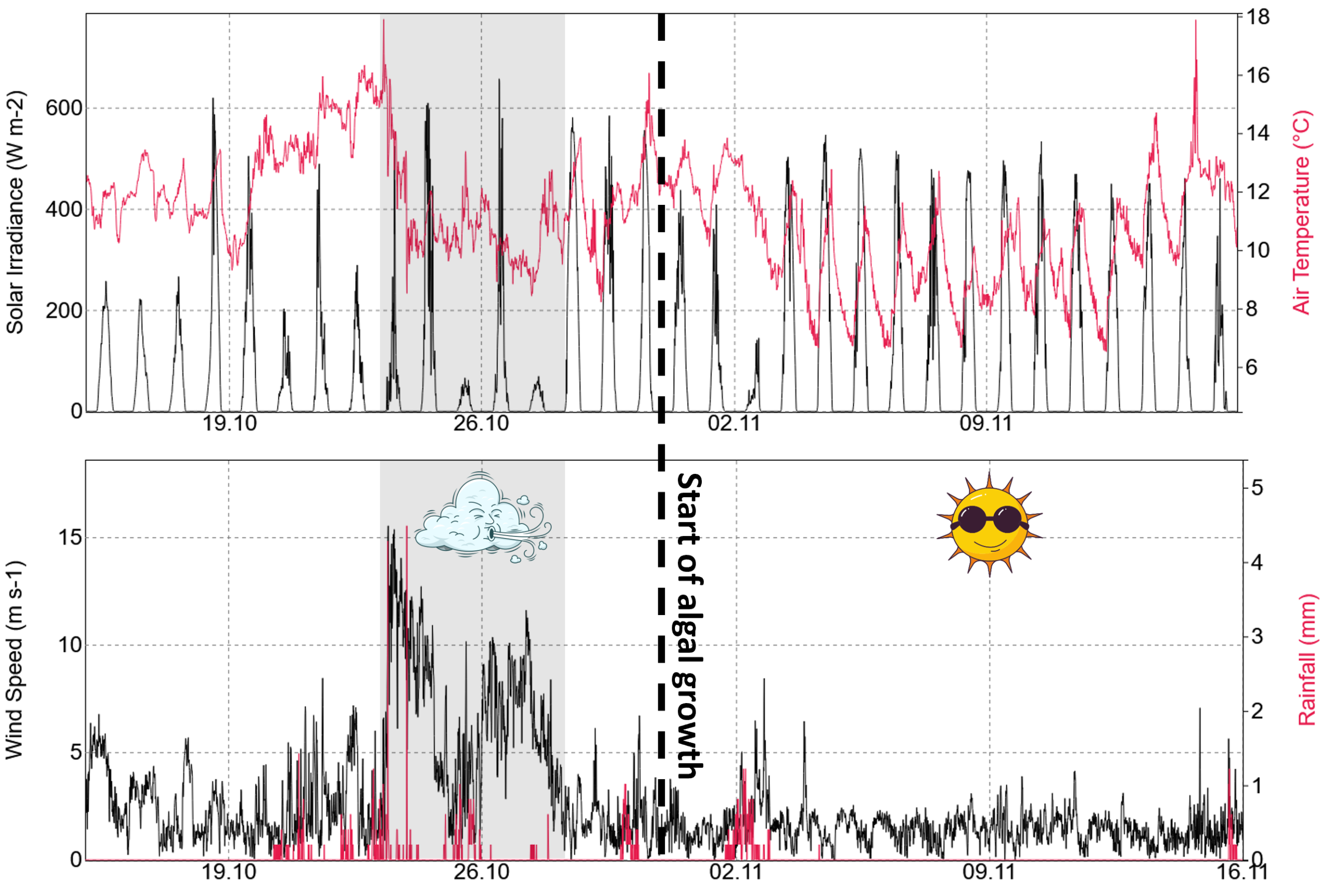
Figure 4 – Meteorological data time series measured by the weather station on the roof of LéXPLORE. Top panel: solar radiation and air temperature, bottom panel: 10-min averaged wind speed and rainfall intensity. The shaded area depicts the Benjamin storm with strong winds. The vertical dashed line indicates the start of algal growth on 31 October as in Fig. 2. Data publicly available at https://www.datalakes-eawag.ch/datadetail/459.
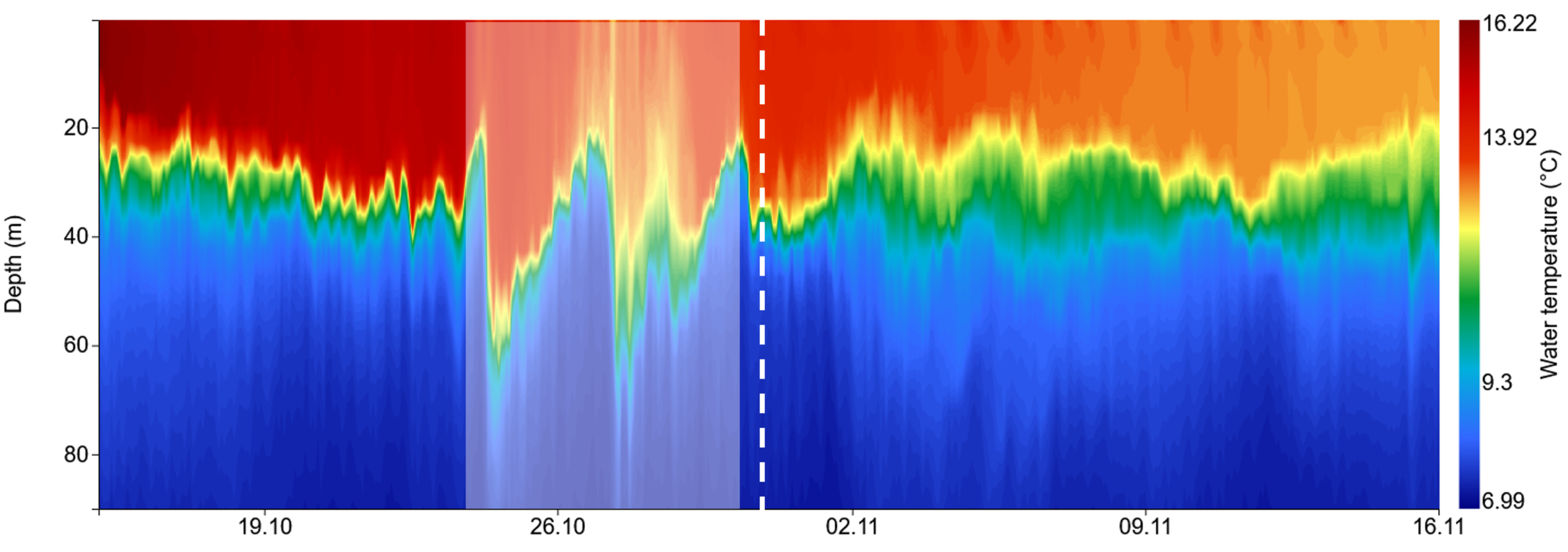
Figure 5 – Water temperature measured at LéXPLORE as a function of time and depth. The shaded area depicts strong thermal oscillations associated with the passage of Kelvin waves (see previous article). The vertical dashed line indicates the start of algal growth on 31 October from Fig. 2. Data publicly available at https://www.datalakes-eawag.ch/datadetail/448.