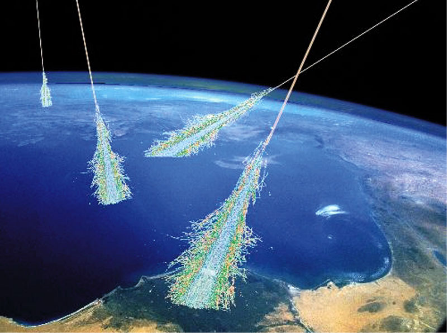
A rendering of Extensive Air Showers, Simon Swordy, http://apod.nasa.gov/apod/ap060814.html
LACTEL: Hunting Cosmic Rays in Lake Geneva
A Telescope Hidden Beneath the Waves
Every second, the Earth is bombarded by particles from outer space called cosmic rays, that travel at nearly the speed of light and carry energies far beyond what any human-made accelerator can produce. When these particles arrive into the upper atmosphere, they trigger cascades of secondary particles called Extensive Air Showers, which rain down to the ground. Detecting and studying these showers is one of the main tools physicists use to understand the most energetic phenomena in the Universe.
The challenge, however, is distinguishing the interesting signals, i.e. showers initiated by gamma rays or electrons, from the overwhelming background of showers produced by ordinary cosmic-ray protons and nuclei. The LACTEL project (LAke-based Cosmic ray electron and gamma-ray TELescope), proposes an interesting solution: use the lake as a particle detector by measuring the faint light emitted by the showers when they enter the water. This light, called Cherenkov light, is produced by charged particles when they travel through water, in much the same way a supersonic aircraft produces a sonic boom. This light is captured by very sensitive photodetectors, called photomultiplier tubes, placed in light-tight tarpaulin compartments full of water, to shield them from ambient light.
By deploying two detection layers at different depths, it is possible to identify the nature of the initial particle that triggered the shower, allowing physicists to separate the rare gamma-ray events from the far more frequent background. The goal is to push gamma-ray and cosmic-ray electron observations into the largely unexplored energy range between 10 and 100 TeV (tera-electronvolts, a measurement of energy): as a comparison, the LHC in Geneva, the largest particle accelerator in the world, accelerates protons up to 14 TeV.
A key ingredient of the project is sustainability: rather than building new detector components from scratch, LACTEL repurposes optical modules from the ANTARES neutrino telescope, an experiment that operated on the floor of the Mediterranean Sea until 2022. Each optical module houses a photomultiplier tube inside a pressure-resistant glass sphere, capable of detecting the faint flashes of Cherenkov light produced when charged particles pass through water.
LéXPLORE: deployment in the Lake
The first deployments have been performed at the LéXPLORE platform, where the knowledge and experience of the personnel has greatly simplified the logistics, installation and operation of the prototypes.
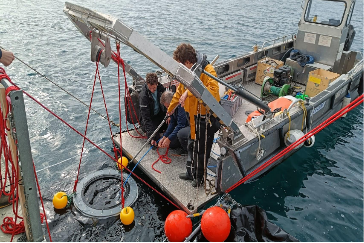
Deployment at LéXPLORE © Guillaume Cunillera, 2025
Deploying such a structure in a real lake comes with its own set of challenges, as the team discovered first-hand. The first two prototypes, installed in 2024 served primarily to validate and refine the mechanical design. The first, deployed in August, revealed structural issues due to the imbalance between the buoyancy of the surface platform and the weight of the underwater compartment. A revised design, using buoys in place of the rigid platform, was deployed in November, and survived the first winter storms before eventually succumbing to mechanical fatigue in February 2025.
A third, further improved prototype was assembled and installed in October 2025. This iteration decoupled the surface superstructure from the underwater compartment, linking them with chains to reduce stress on the structure. It proved significantly more robust: the detector survived the entire winter, enduring repeated storms and waves, with limited damage.
First Light: A Night of Data Taking
With a working structure finally in place, the team moved on to the first real test of the full data acquisition chain. The electronics box was placed on a small boat moored in the lake, connected to the optical modules. The whole system was operated remotely during the night for several consecutive nights.
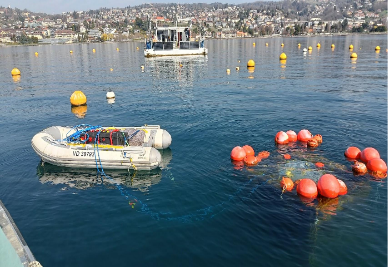
Setup for the first data acquisition © Guillaume Cunillera, 2025
The data acquisition software recorded pulses from the photomultiplier each time a charged particle crossed the water tank and produced a Cherenkov flash. The system performed stably throughout the night, demonstrating that the readout electronics and communication chain work as intended in real outdoor conditions.
This first data-taking campaign is an important milestone: it confirms that the detector concept is sound and that the path towards a full multi-cell array is open. The team is now focusing on the construction of multiple elementary cells, which will be installed in a smaller lake later in 2026.
The LACTEL project demonstrates LéXPLORE’s potential as a testing platform for innovative technologies, extending well beyond limnology. By providing a unique environment for the development and validation of scientific instruments under real-world conditions, LéXPLORE helps advance research across a wide range of fields, including particle physics, environmental sciences, and the observation and monitoring of aquatic ecosystems.