
LéXPLORE Blog #1A – January 2025
Lake Geneva’s hidden response to the Benjamin storm
When the Benjamin storm hit Switzerland on 23 October 2025, it generated large waves on Lake Geneva. But the most important response of Lake Geneva was hidden below the surface. Let’s éXPLORE how a storm can set the lake’s interior in motion!
Strong winds on the lake
On 23 October 2025, the Benjamin storm hit Switzerland. Strong southwest winds, with averaged speeds of 50 km/h (15 m/s), and gusts up to 80 km/h, were measured at LéXPLORE on that day (Fig. 1). These strong winds persisted until the afternoon of 24 October, followed by a second peak on 26-27 October.
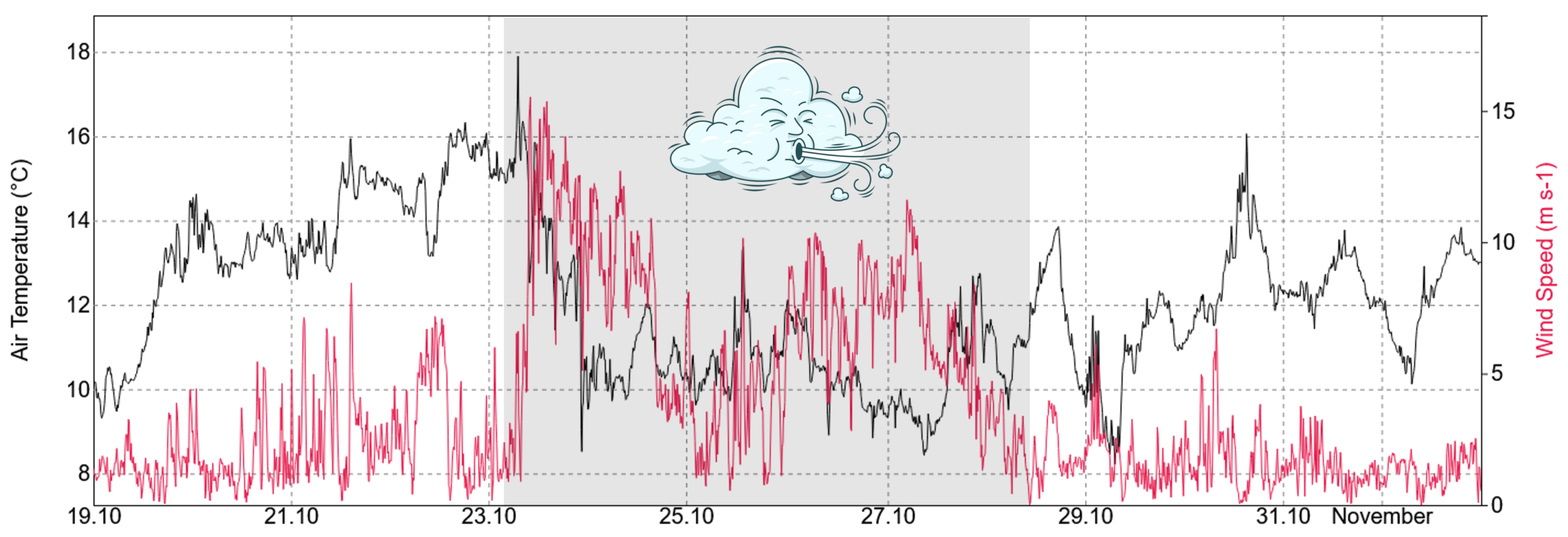
Figure 1 – Air temperature (black) and 10-min averaged wind speed (red) measured by the weather station on the roof of LéXPLORE. The shaded area depicts the period with strong winds associated with the Benjamin storm. Data publicly available at https://www.datalakes-eawag.ch/datadetail/459.
An opposite response at the two lake ends
Lake Geneva’s response to the storm was very different between Geneva (western lake end) and Le Bouveret (eastern lake end). The strong southwest winds generated northeastward surface currents reaching 0.5 m/s from Geneva to the lake center (Fig.2). These currents pushed surface waters towards Le Bouveret, and brought deep, cold waters to the surface in Geneva – a process called upwelling (Fig. 3). Surface temperatures in Geneva dropped from 16°C to 6°C in just a few hours! At the same time, the opposite process – called downwelling – occurred in Le Bouveret: warmer surface waters were pushed down to 40 m depth during both wind events (Fig. 4).
Figure 2 – Surface temperature and currents during the Benjamin storm (21 October 2025 – 2 November 2025) simulated by a 3D numerical model. Data publicly available at https://www.alplakes.eawag.ch/map/geneva?layers=3D_temperature%2C3D_currents.
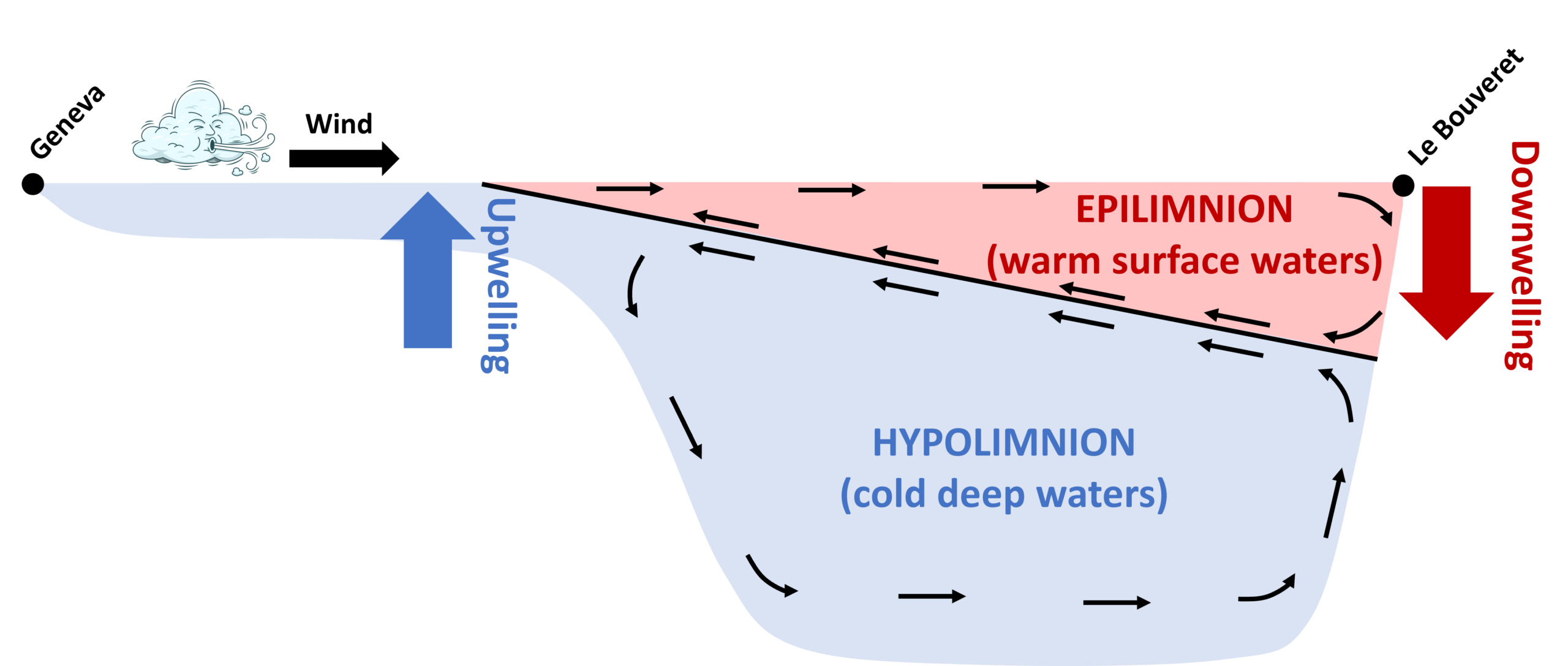
Figure 3 – Schematic of the upwelling-downwelling mechanism caused by the southwest winds from the Benjamin storm.
Waves and mixing well below the surface
When the wind weakened in the afternoon of 24 October, the deep pool of warm water formed at the downwelling end traveled along the northern lake shore, from Le Bouveret to Lausanne (Fig. 4). A similar process occurred after the second wind event on 28 October. These two events correspond to Kelvin waves, waves that propagate at 30 m depth along the interface between surface and deep-water layers and travel along the lake boundary. The passage of these waves at LéXPLORE generated 40 m large thermal oscillations and current velocities of 0.2 m/s at 60 m depth (Fig. 5), showing that the interior of Lake Geneva was very dynamic.
Take-home message: a storm like Benjamin does not only produce surface waves but also currents and mixing well below the surface. How do these hidden dynamics affect aquatic life? Answer in the following article!
Figure 4 – Temperature and currents at 40 m depth during the Benjamin storm (21 October 2025 – 2 November 2025) simulated by a 3D numerical model. Data publicly available at https://www.alplakes.eawag.ch/map/geneva?layers=3D_temperature%2C3D_currents.
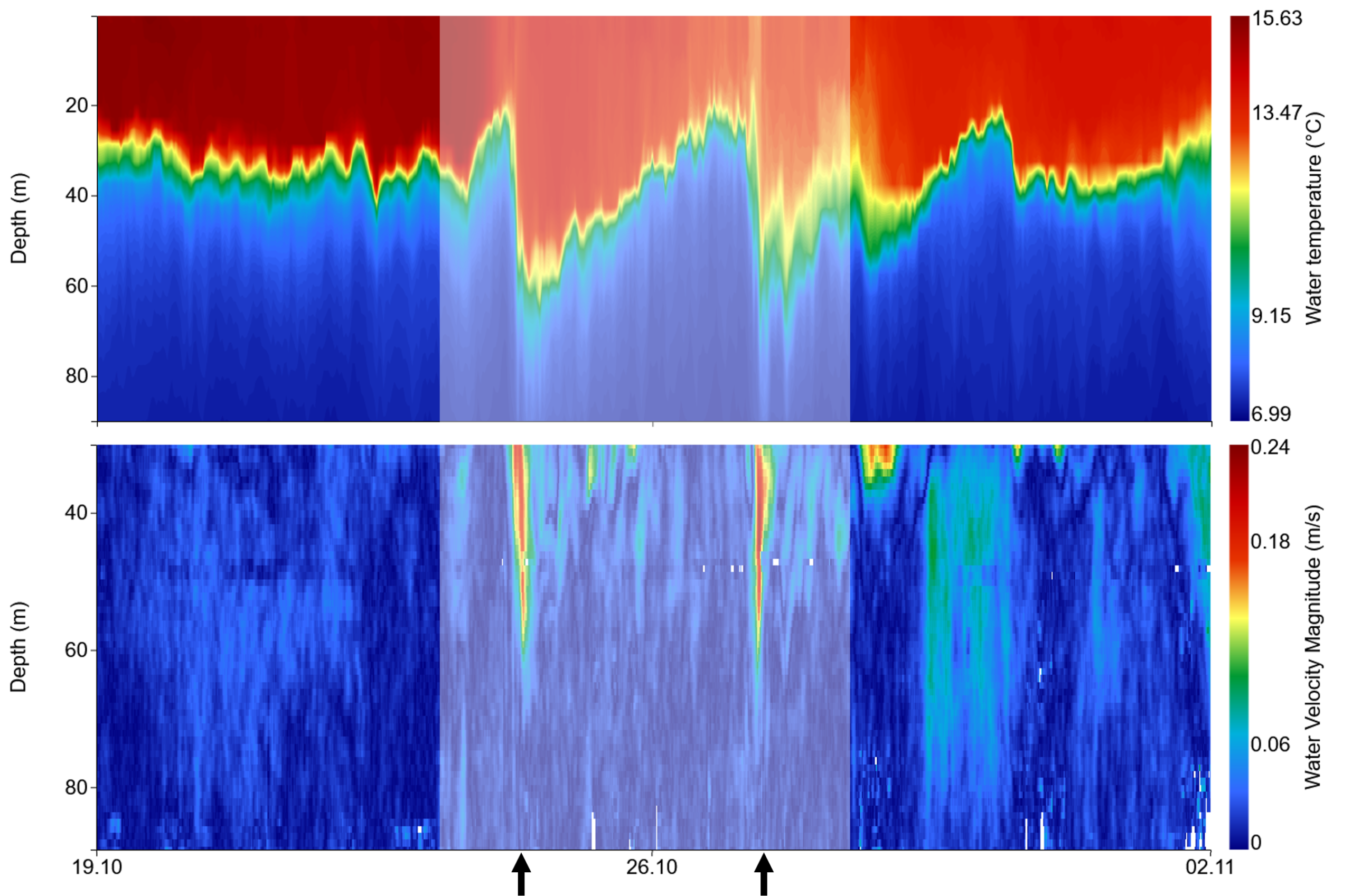
Figure 5 – Water temperature (top panel, 0-90 m depth) and velocity (bottom panel, 30-90 m depth) measured at LéXPLORE as a function of time and depth. The two arrows indicate the passage of two Kelvin waves. The shaded area depicts the period with strong winds from Fig. 1. Data publicly available at https://www.datalakes-eawag.ch/datadetail/448 (temperature) and https://www.datalakes-eawag.ch/datadetail/599 (velocity).